
We all have duty to care.
And there is ONE person who can make a difference.
It’s YOU!
We all have duty to care.
And there is ONE person who can make a difference.
It’s YOU!

In today’s society, entire groups of people are systematically deprived of social recognition, equal opportunities, resources and social value based on the familiar fault lines of socio-economic class, educational status, geographic location, physical ability, race, ethnicity, age, nationality, religion, and gender.
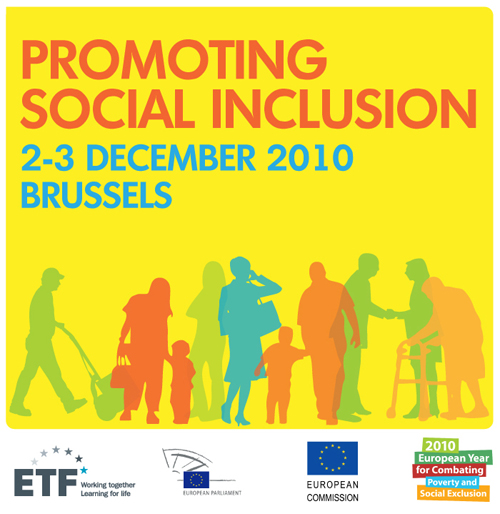
Poverty divides us but social inclusion can unite. This is the focus of the conference (Promoting Social Inclusion), which will take place in Brussels on 2-3 December 2010.
Social inclusion is promoted in the digital age through the production and deployment of the new media such as weblogs, wikis, podcasts, Internet forums, pictures and videos that give voice to the experiences of socially, racially, politically and economically marginalized individuals, communities, and institutions.
Can the use of social media lead to better social inclusion?
Social media is changing the way we work. People turn to the web to find out about many things – from days out, new jobs, housing, entertainment and shopping, to making connections with friends and colleagues.
Social media is having an impact on both formal and informal learning – and changing the face of both education and training.
Social media support more engaging and playful approaches, provide new formats for creative expression, and encourage learners and teachers to experiment with different, innovative, ways of articulating their thoughts and ideas.
The learning landscape itself is in turn shaped by experimentation, collaboration and empowerment, and allows learners and teachers to discover new ways of actively and creatively developing their individual competences.
With the emergence of social media applications, which encourage a more active and interactive Internet usage, this trend is developing further. These services provide users with online networks and communities for multi-directional communication and knowledge exchange and allow them to publish and share digital content like photos, videos and music.
Social media can actively support lifelong learning by offering accessible, flexible and dynamic learning environments that can complement and supplement initial training. Furthermore, the networking potential of social media, together with its power to overcome time and space barriers, supports interaction and collaboration among and between learners and teachers who are geographically dispersed and enables students to broaden their horizons, and collaborate across borders, language barriers, and institutional walls.
Building societies for all is one of the conference sessions, which will introduce the role of the social media in combating poverty and promoting social inclusion.
We encourage you to join the conversation with our speakers and social media experts (Silvia Cambié and Mark Comerford) and interact with them to explore how social media can engage communities and people on the ground to support social inclusion with a particular focus on education and training.
Share your thoughts with us.
By: Jasmine Elnadeem
Education can provide the opportunity for millions of people to overcome poverty, lead healthy and productive lives and contribute to global stability and prosperity.
It is in this context that the European Training Foundation (ETF), in partnership with EU institutions and international actors, is organizing a two-day conference entitled “Promoting Social Inclusion” on 2-3 December 2010 in Brussels.
The purpose of the event is to enhance policy dialogue and cooperation for promoting social inclusion and combating poverty through education, training and work.
The event will build upon existing experience in EU neighbouring countries, the European Union, the ETF and others on this topic to consider how education, training and employment systems can better promote social inclusion and combat poverty, and identify future avenues for cooperation.
The conference will consist of plenary discussions and thematic workshops on youth employment, the gender dimension and partnerships for social inclusion. The conference will also make use of web-based interactive tools for communication in order to involve, virtually, more participants in the debates.
The workshop “Youth Employability” will provide space for dialogue and the sharing of innovative ideas and practices for promoting social inclusion and combating poverty among youth and young adults, focusing particularly on their preparedness for getting and retaining employment. The discussion will be directed at institutions as well as policies and processes, which address youth employability as an important means to reduce youth inequality and marginalisation in the labour market.
By: Jasmine Elnadeem
 Jasmine Elnadeem